A Simple Flooring Request Turned Into a Bigger Design Conversation
There’s a moment that happens more often than you’d think.
A client reaches out with what seems like a simple request:
“We just need gym flooring installed.”
On the surface, it sounds straightforward. The space is already designed. The plans are done. The finishes are selected.
But then we review the drawings.
And that’s where things start to unravel.
This particular project was an ADU designed as a hybrid fitness space and office. The client already had a designer involved and came to us purely for flooring. Our job should have been calculating square footage, confirming material needs, and coordinating the installation.
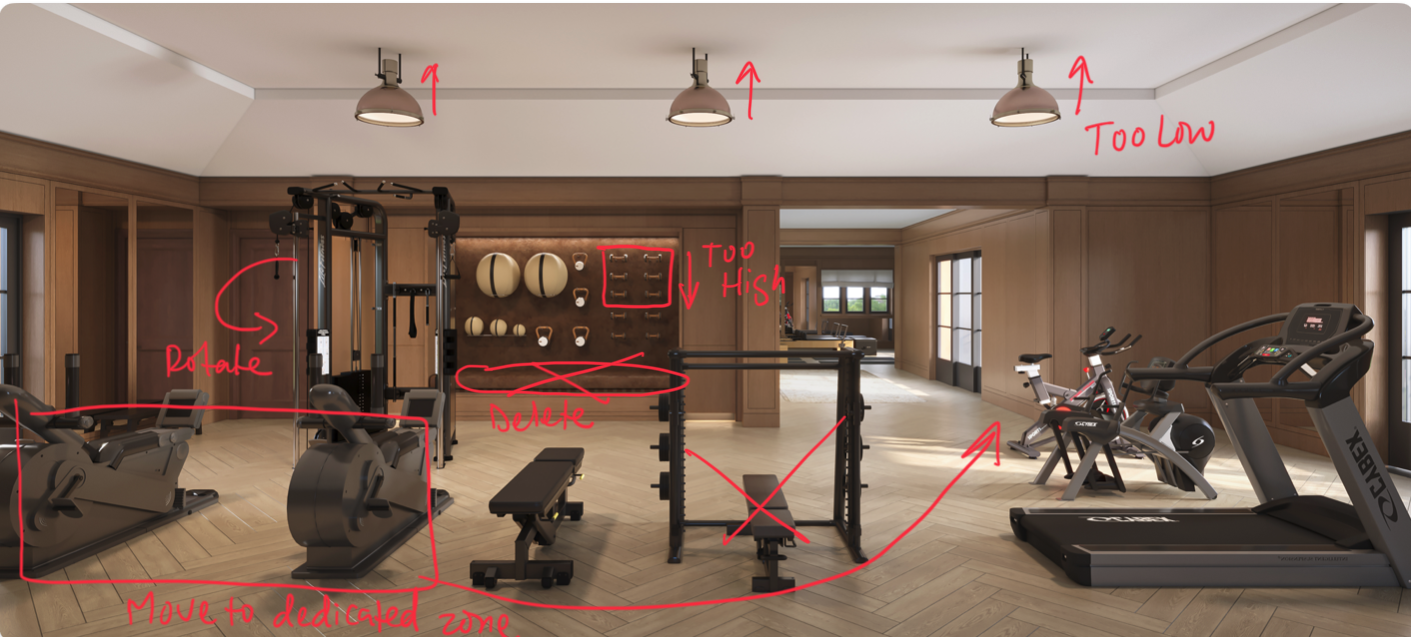
Instead, we found ourselves identifying several layout issues that could have impacted how the gym functioned every single day.
Not because the design was bad. In fact, aesthetically, it was strong.
The issue was that the space wasn’t designed through the lens of how a gym actually functions.
And that distinction matters.
Beautiful Design Does Not Always Mean Functional Design
Here’s the simplest way to think about it:
You probably wouldn’t hire a kitchen designer to design your landscape.
Could they make it look beautiful? Absolutely. They would likely select materials, colors, and textures that feel thoughtful and elevated.
But long-term, you might discover issues that only a landscape expert would have caught.
Maybe the plants aren’t right for the climate. Maybe they need more shade than the space provides. Maybe they aren’t as drought-resistant as you thought. Maybe the drainage wasn’t considered properly.
The same principle applies to fitness spaces.
A gym is not just a room with equipment in it. It is a performance environment.
It has to account for movement, clearance, safety, training style, flooring, storage, equipment access, impact, acoustics, ventilation, and long-term use.
If those details are missed, the space may look beautiful but still fail the person who has to use it.
The Problem With Designing a Gym Only on a 2D Plan
One of the most common home gym layout mistakes is assuming that if equipment fits on a 2D plan, it will work in real life.
But gym equipment does not function as a static object.
People need space to move around it. Barbells need room to be loaded and unloaded. Dumbbells need to be picked up, carried, lifted, and re-racked. Benches need to be repositioned. Cable machines need working clearance. Recovery equipment needs access, ventilation, and sometimes plumbing or electrical coordination.
A piece of equipment may technically “fit” in a room while still being completely impractical to use.
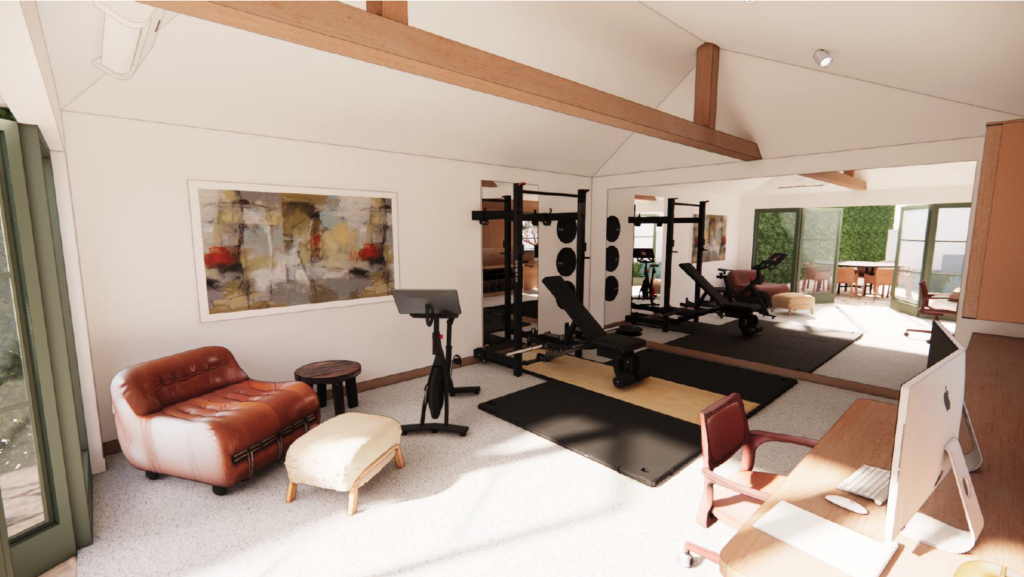
That was one of the main issues in this project. And that’s even with having a 3D model!
Layout Issue #1: The Squat Rack Had No Functional Clearance
In the proposed layout, the squat rack was placed in a way that looked acceptable on paper.
But in practice, there would have been no functional room to load and unload a barbell.
That creates several problems.
First, the user would be forced into an awkward position every time they changed plates. Second, the barbell could come dangerously close to the mirror. Third, the daily experience of using the rack would become frustrating, cramped, and potentially unsafe.
This is exactly why gym planning requires more than placing equipment symbols into a room.
You have to understand how the equipment is actually used.
A squat rack is not just the footprint of the rack itself. It also requires room for the barbell, the plates, the person lifting, the person loading, and the movement happening around it.
When those clearances are ignored, the gym becomes harder to use before the first workout even happens.
Layout Issue #2: The Dumbbell Storage Looked Beautiful, But Wasn’t Practical
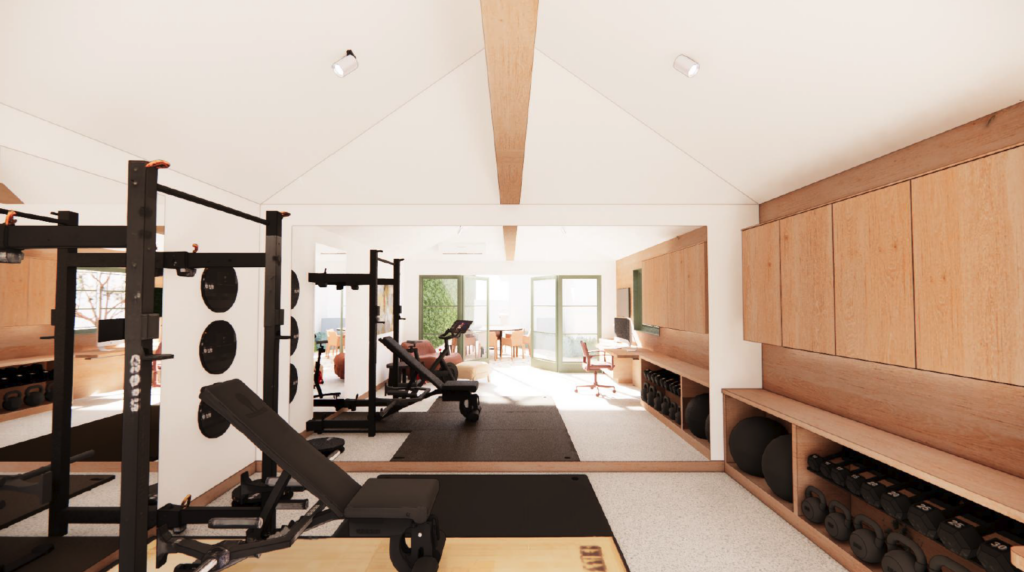
Another issue was the proposed dumbbell storage.
The designer had created a beautiful under-cabinet storage system for the dumbbells. Aesthetically, it looked clean, integrated, and intentional. I genuinely understood what they were going for.
But functionally, it created a problem.
Traditional dumbbells, especially heavier dumbbells, are not easy to slide in and out of a low cabinet system while navigating a countertop, cabinet face, and surrounding woodwork.
As the dumbbells get heavier, the movement becomes increasingly awkward. The user has to bend, maneuver the weight, protect the surrounding surfaces, and avoid damaging the cabinetry or countertop.
That might be manageable with a light pair of dumbbells. But it becomes a completely different story when you are working with heavier weights.
A gym has to be designed for real use, not just the first impression.
Because over time, those small inconveniences become the reason someone stops using the space.
Why Fitness Spaces Require a Specialist
This is where expertise matters.
I have designed other spaces before, including a kitchen. The client was happy with the final aesthetic, but looking back, I know there were details I would have handled differently if I had been a kitchen design specialist.
That experience gave me a lot of respect for the nuance inside every discipline.
Specialized spaces require specialized knowledge.
And gyms are no different.
I’ve been in the fitness and gym design world for over 20 years. I started as a personal trainer, then worked as a strength coach, and spent years inside a wide range of training environments.
I’ve toured, worked in, exercised in, and designed large-scale recreation centers, collegiate strength and conditioning facilities, professional-level training environments, boutique gyms, commercial fitness spaces, and residential gyms.
Each one teaches you something different.
Over time, you learn what works, what breaks down, what gets ignored, what creates bottlenecks, and what makes a space feel effortless to use.
That experience is what we bring into home gym design.
A Home Gym Has to Be More Than a Pretty Room
A home gym is not a commercial gym copied and pasted into a house.
It has its own set of rules.
It has to support the way someone trains, but it also has to live within the architecture of the home. It may need to feel elevated, quiet, beautiful, and connected to the rest of the property.
But it also needs to perform.
That means the equipment layout needs to make sense. The flooring needs to support the training style. The mirrors need to be placed where they are useful and protected. The storage needs to be accessible. The room needs enough negative space for movement.
Most importantly, the gym needs to be easy to use.
Because if the room becomes too cramped, too crowded, or too annoying to use every day, it will not matter how much money was spent on it.
It will become the most expensive gym you never use.
The Most Expensive Home Gym Mistake Is Building a Space You Avoid
The biggest mistake in home gym design is not choosing the wrong dumbbells or the wrong flooring color.
The biggest mistake is creating a space that looks good, but creates friction.
Friction shows up in small ways.
The bench is hard to move.
The rack is too tight.
The dumbbells are annoying to access.
There is nowhere to stretch.
The mirror feels vulnerable.
The cardio equipment feels crammed into a corner.
The room technically works, but never feels good.
And when a gym doesn’t feel good to use, people stop using it.
That is the real cost.
Not the equipment. Not the flooring. Not the cabinetry.
The real cost is investing in a wellness space that does not support your actual life.
When to Bring in a Home Gym Expert
The best time to bring in a home gym expert is before construction decisions are finalized.
Ideally, this happens while the architect, builder, or interior designer is still working through the plans. That allows the fitness layout to inform electrical, lighting, flooring, mirrors, storage, ceiling heights, clearances, ventilation, and equipment selection.
But even if the plans are already underway, there is still value in having a specialist review the space before materials are ordered and construction moves too far forward.
In this particular project, we were originally asked to install flooring.
But because we reviewed the plans first, we were able to catch issues that could have impacted the entire functionality of the space.
That is often where we provide the most value.
Sometimes we design the entire gym from the ground up. Other times, we step in as a second set of expert eyes.
Both matter.
What Beachside Custom Gyms Looks For During a Plan Review
When we review a proposed home gym or wellness space, we are not just looking at whether the equipment fits.
We are looking at how the room will actually function.
That includes:
- Equipment layout and flow
- Barbell and dumbbell clearances
- Flooring requirements
- Mirror placement
- Wall protection
- Storage usability
- Electrical and equipment coordination
- Lighting placement
- Ventilation needs
- Recovery zone planning
- Office and fitness space overlap
- Long-term durability
- Daily ease of use
The goal is not to overcomplicate the project.
The goal is to prevent expensive mistakes before they happen.
If you are planning a home gym, ADU fitness space, wellness room, or office and gym combo, Beachside Custom Gyms can review your plans before construction or installation begins.
We help homeowners, builders, architects, and designers create fitness spaces that are beautiful, functional, durable, and built around real use.
Book a Design Advisory Session or Plan Review before you finalize your gym layout.